Eyes Up: Why Schools Are Reconsidering Cell Phones in the Classroom

As both an educator and a parent, I have watched the conversation surrounding cell phones in schools change dramatically over the years.

I remember when the biggest concern was whether students were texting under their desks or sneaking a quick glance at social media during class. While those concerns certainly still exist, the conversation has grown into something much larger.

Today, schools across the country are wrestling with a question many parents are asking at home: How do we help our children stay focused in a world designed to distract them?

It is a question many of us are asking at home, too.

Like many parents, I have seen firsthand just how powerful technology can be. I have watched my own children become completely absorbed in a screen, unaware that they have been called for dinner three times. If we’re being honest, most adults can probably relate. How many times have we picked up our phones to check one email or look up a recipe, only to realize twenty minutes have somehow disappeared?

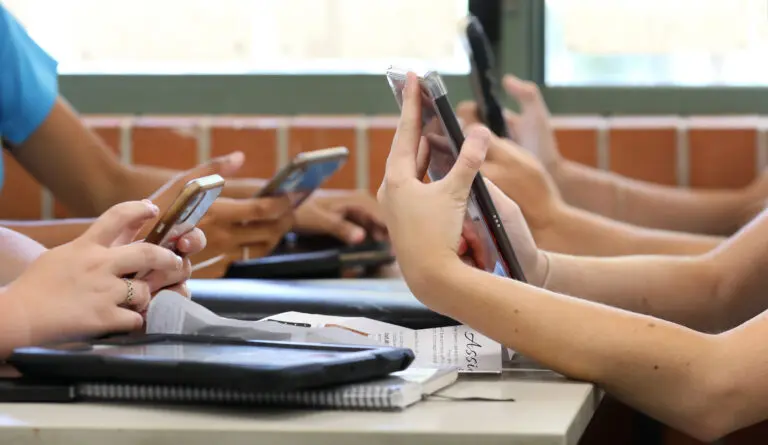
Close-up of several people’s hands holding smartphones over a desk with papers and a tablet nearby.

Our students are growing up in a world where apps, games, videos, and social media feeds are constantly competing for their attention. It is no wonder that focusing for an extended period of time can be difficult, even for adults.

That reality has prompted many school districts to take a fresh look at cell phone policies. Some schools have adopted bell-to-bell phone bans. Others require students to keep devices in lockers or secured pouches during the school day. Still others are working to find a middle ground, allowing limited use under teacher supervision.

While policies may differ from district to district, the goal is often the same: helping students focus, engage with their classmates, and be fully present in the learning process.

Educators in districts that have implemented stricter cell phone policies frequently report positive changes. Teachers often report that students talk to one another more, classroom discussions improve, and there are simply fewer distractions competing with instruction. Many schools have also seen a decline in disciplinary issues tied to social media conflicts that once followed students into the classroom.

Of course, removing phones during the school day does not magically solve every challenge facing today’s students.

Technology is woven into nearly every aspect of modern life, and digital tools offer tremendous benefits when used intentionally. Students will graduate into a world that requires them to communicate, collaborate, research, and work in digital environments. Schools have an important role to play in preparing them for that future.

That is why this conversation cannot stop with simply putting phones away.

Students also need opportunities to develop strong media literacy skills. They need to understand how algorithms shape what they see online, how to evaluate the credibility of sources, how misinformation spreads, and how digital habits can affect everything from productivity to mental health.

In many ways, teaching students how to manage technology responsibly has become just as important as teaching them how to use it.

The conversation about cell phones in schools is ultimately about helping students build healthy habits that will serve them long after graduation.

Our children will always live in a digital world. The challenge for schools and families is helping them learn when to put the phone down, look up, and fully engage with the people and opportunities right in front of them.

That may be one of the most important lessons we teach.

Ready to connect with the institutions that need your expertise most? Explore Agile’s Education Market insight to find the right opportunities today.

Author

Meredith Biesinger

Meredith Biesinger is a licensed dyslexia therapist, in addition to being an experienced classroom teacher and K-12 administrator. Meredith also works as a consultant, where she bridges the bridge the gap between K-12 school districts and ed-tech organizations. With a passion for literacy, she is also a professional writer and syndicated author. With a M.Ed in Educational Leadership and a B.S. in English Education and Creative Writing, she has had rich and diverse opportunities to teach students and education professionals in different parts of the country as well as overseas.

Related Posts

Chalkboard reading 'summer vacation' with a yellow alarm clock and school supplies on a desk.

What Students Lose Over Summer Isn’t Just Learning—It’s Connection

Every June, the conversation starts again.

Teachers worry about summer learning loss. Parents buy workbooks they hope their children will actually open. Schools share reading lists and encourage students to keep practicing math facts before August rolls around.

There’s nothing wrong with any of that. Academics matter.

But lately, I’ve found myself thinking about something else.

Read More »

education expertise matters

Consultation
Request

Districts of Distinction

Learn More

EdIntel.AI™

Get Started

We use cookies to ensure you get the best experience on our website.  Learn more.

Optimize Your Digital Marketing

Let's Get Started

Optimize Your Digital Marketing

Let's Get Started

education expertise matters

Let's Connect

We’re here ready to answer your questions! Share a little information with us below and one of our Agile experts will be in touch shortly.

Making Data Useful Daily

Let's Get Started

See Agile Integrations in Action

Connect to
Learn More

Plug Into the Education Market

Get Started

education expertise matters

Consultation
Request

education expertise matters

Consultation
Request