How Education Data Powers Stronger Pipelines: A Guide for Sales and GTM Leaders

If your team is selling into K–12 or higher education, your pipeline is only as strong as the data behind it. The right education data doesn’t just help marketing—it reshapes territory plans, prospecting lists, and sales motions so your reps spend their time where they can actually win.

In this guide, we’ll look at how education data transforms sales performance, from coverage and pipeline quality to win rates and sales velocity.

Why education sales is uniquely data‑dependent

Selling to schools is not like selling into a typical B2B vertical. District hierarchies, funding cycles, and buying committees add layers of complexity that most CRM data simply wasn’t built to handle. On any given opportunity, your reps need to know:

  • Which districts or institutions are genuinely in‑market for your type of solution
  • Who sits on the buying committee—administrators, instructional leaders, IT, specialists, and end users
  • What funding and program priorities are shaping decisions right now
  • When budgets are likely to be allocated or renewed

Without that context, teams default to broad lists, generic messaging, and guesswork about timing. That leads to low connect rates, stalled opportunities, and deals that quietly die in “no decision.” Education‑specific data changes this. It gives your GTM organization a shared, reliable view of the market so you can prioritize accounts, design territories, and equip reps with the insight they need at every stage of the sales cycle.

Step 1: Build full market coverage, not just a list

For most vendors, the first breakthrough comes when they realize their “total addressable market” in education is incomplete. Generic business databases often miss entire districts, campuses, roles, or program areas that could be high‑fit for your solution.

Education data helps you:

  • Map the full K–12 and higher ed landscape you can serve—by district, school, or campus type
  • See how many of those accounts you actually have in your CRM today
  • Identify coverage gaps where your reps currently have zero visibility


For GTM leaders, this turns market sizing into something concrete: you can quantify how much opportunity is invisible to your current team because the records simply don’t exist in your systems.

Once you close those gaps using a partner like Agile Education Marketing—with human‑verified school and contact data—you can set more realistic territory and pipeline targets based on actual market coverage.

Step 2: Prioritize accounts with the highest potential

Coverage alone isn’t enough; your reps need to know where to start. That’s where education‑specific attributes become a powerful prioritization engine.

With robust school and district data, you can score and rank accounts using factors like:

  • Enrollment and size: Larger student populations often mean larger potential contracts.
  • Demographics and performance: Indicators such as performance gaps or program needs can signal urgency for certain solutions.
  • Funding and grants: Budget allocations, grant awards, and per‑student spending levels suggest where purchasing power exists now.
  • Programs and initiatives: Participation in STEM, literacy, SEL, or other initiatives shows where your solution fits.


For sales and RevOps, these fields form the backbone of a scoring model tailored to the education market. Accounts that align closely with your ideal customer profile can be pushed to the top of rep queues, while lower‑fit districts and institutions are de‑prioritized or reserved for automated nurture.

The result: your team spends more time on schools that are both a strong fit and more likely to buy in the near term, which has a direct impact on win rates and quota attainment.

Step 3: Give reps the right contacts and buying‑committee visibility

Even the best‑scored district won’t convert if your reps are talking to the wrong people. In education, that risk is especially high because decisions often involve multiple roles—curriculum leaders, principals, IT directors, department chairs, and more.

High‑quality education contact data helps you:

  • Identify the full buying committee, not just a single “decision‑maker”
  • Distinguish between influencers, evaluators, approvers, and end users
  • Keep up with role changes and staff turnover, which are common across schools and districts


This visibility empowers reps to multi‑thread deals more effectively. Instead of relying on a single champion, they can build relationships across the team that will evaluate, pilot, and implement your solution.

For GTM leaders, it also opens the door to coordinated plays: marketing can warm up a broader audience while sales runs targeted outreach to key decision‑makers, using the same clean, up‑to‑date contact universe.

Step 4: Time outreach to match education buying cycles

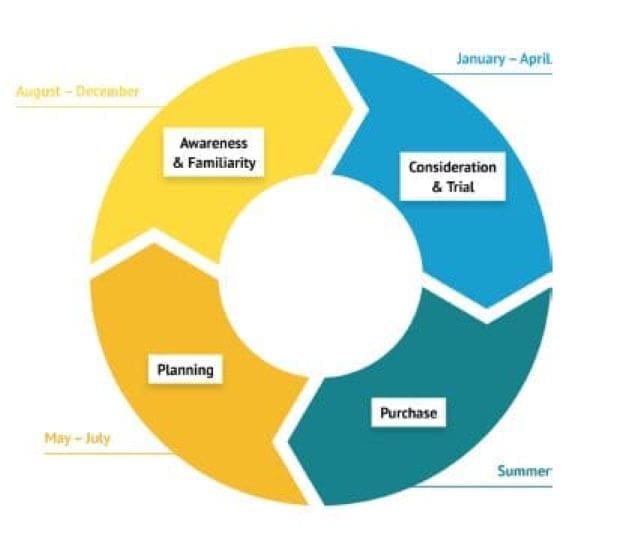
One of the biggest reasons education deals stall is misaligned timing. Budgets in K–12 and higher ed are shaped by fiscal calendars, grant windows, and planning cycles that rarely match a standard B2B sales model.

Education data and market insight help you answer questions like:

  • When do target districts typically make decisions for your category?
  • Which schools recently received relevant funding or grants?
  • Where are there signs of new initiatives or programs that align with your solution?

Instead of pushing the same outreach cadence all year, sales and GTM leaders can plan waves of activity around budget planning, board approvals, and implementation windows.

Your reps become much more effective when they are:
Purchasing Cycle Graphic img
  • Reaching out to prospects shortly before or during key planning meetings
  • Framing conversations in terms of current funding sources and priorities
  • Avoiding periods when decisions are unlikely, reducing frustration and wasted effort


Over time, this data‑driven timing can materially shorten your sales cycle because more of your conversations happen when schools can actually move forward.

Step 5: Use omni‑channel data to increase connect and meeting rates

Most sales teams still lean heavily on email and phone for educator outreach. The challenge: educators and administrators are overloaded, and they do not live solely in their work inboxes.

Omni‑channel education data—combining school and home contact information and digital identifiers—opens up new ways to reach the same decision‑makers more effectively.


For sales and GTM teams, this can translate into:

  • Higher match rates for contact records, so more attempts actually reach a real person
  • Better performance from sequences that blend personal email, professional email, and coordinated digital touch points
  • Stronger air cover from marketing campaigns that warm up accounts before SDRs and AEs reach out


When Agile analyzed omni‑channel education campaigns, the data showed dramatic improvements in engagement, match rates, and cost efficiency, underscoring why multi‑channel outreach matters so much in this space.

Step 6: Turn data into sales plays your team can repeat

Data only changes outcomes when it’s translated into clear, repeatable motions your reps can follow. That’s where sales playbooks come in.


Using education data and market insight, you can build plays such as:

  • “New STEM funding” play: Prioritized districts with recent STEM grants, mapped stakeholders, and tailored talk tracks tying your product to grant objectives.
  • “Literacy improvement initiative” play: Districts showing reading performance gaps and literacy programs, with sequences that speak directly to those goals.
  • “Campus expansion” play: Higher‑ed institutions expanding programs or facilities, with outreach that emphasizes scalability and student outcomes.


Each play should include:

  • Who to target (segments and roles)
  • Why now (funding, performance, or program triggers)
  • What to say (messages tied to their goals and constraints)
  • How to follow up (channels, cadence, and next steps)


When these plays are built on accurate, education‑specific data, they become assets your GTM organization can use quarter after quarter, even as the market evolves.

What this means for GTM and revenue leaders

For CROs, VPs of Sales, and GTM leaders, education data is not just “nice to have.” It is the foundation for:

  • Realistic pipeline targets based on actual market coverage
  • Territories that balance opportunity and workload fairly
  • Prospecting that focuses reps on accounts with true buying potential
  • Multi‑threaded deals that move faster and close more consistently
  • Coordinated plays that align sales, marketing, and RevOps around the same strategy


When you bring the right education data into your CRM and workflows—through a partner built specifically for this market—you give your team the visibility and confidence they need to hit ambitious growth goals in a complex space.

Next steps: Put your data to work

If you’re wondering whether your current education data can support the kind of focused, high‑performing sales motions described here, start with three questions:

  1. Do we have a complete and accurate view of our K–12 and higher ed market?
  2. Can we easily see which districts or campuses are “high‑fit and in‑market” based on funding, performance, and program signals?
  3. Do our reps have reliable access to the full buying committee for priority accounts?


If the honest answer to any of these is “not yet,” it may be time to revisit the data powering your pipeline. Partners like Agile Education Marketing specialize in helping vendors find and win more education customers with human‑verified educator data, market intelligence, and omni‑channel insights tailored to how schools actually make decisions. Ready to learn more? Contact us today. 

Author

Ali Newcomb

Ali, VP of Marketing at Agile Education Marketing, is a strategy development specialist with over 20 years of experience in the education market. Prior to joining Agile, she held leadership roles at Pearson, McGraw-Hill, and InsideTrack and earned her Master of Business Administration from the University of Colorado.

Related Posts

education expertise matters

Consultation
Request

Districts of Distinction

Learn More

EdIntel.AI™

Get Started

We use cookies to ensure you get the best experience on our website.  Learn more.

Optimize Your Digital Marketing

Let's Get Started

Optimize Your Digital Marketing

Let's Get Started

education expertise matters

Let's Connect

We’re here ready to answer your questions! Share a little information with us below and one of our Agile experts will be in touch shortly.

Making Data Useful Daily

Let's Get Started

See Agile Integrations in Action

Connect to
Learn More

Plug Into the Education Market

Get Started

education expertise matters

Consultation
Request

education expertise matters

Consultation
Request